
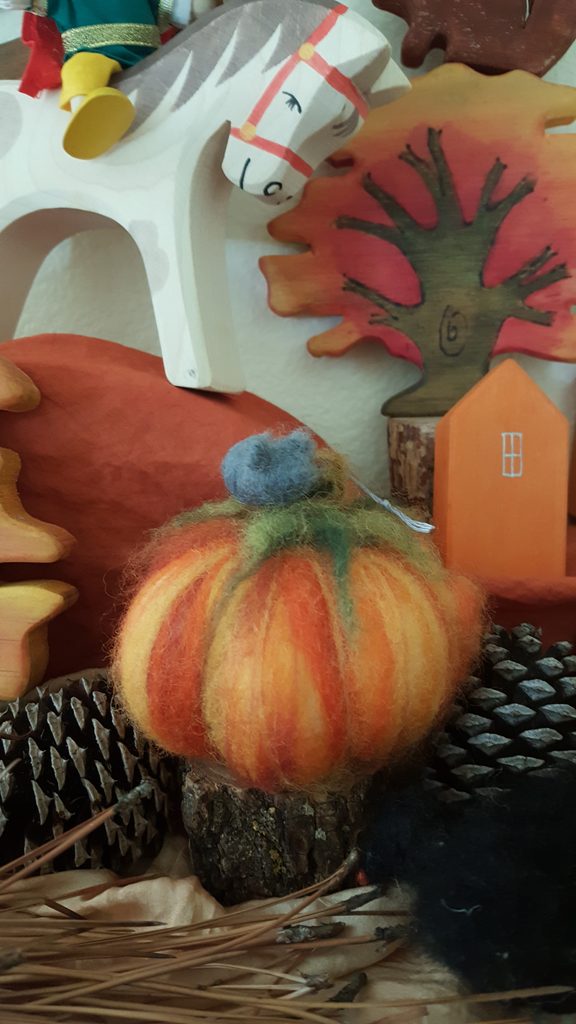
There is a particular kind of treasure that belongs almost entirely to childhood.
A feather found beside the path, three acorns carried home in a pocket, a stone with one shining vein running through it, the first yellow leaf, a seed pod whose little chambers have opened, or a flower that was simply too beautiful to leave behind can all become deeply important in the hands of a child.
Children are always bringing the world home.
A nature table simply gives those small offerings somewhere to belong.
It does not need to be elaborate. In fact, I think it is loveliest when it is not. A low shelf, the corner of a dresser, a little wooden table near a window, or any small place a child can reach will do. What matters most is that there is somewhere for the things gathered outdoors to quietly accumulate.
You might begin with a cloth. It could be green while the world is lush, golden as summer deepens, rust or rose when autumn begins to make itself known, blue during the colder months, or pale green when the first tender leaves return. The color does not have to announce the season perfectly. It only needs to feel a little like the world outside.
Then it helps to leave some room.
That empty space matters because a nature table is not really something we decorate for children. It is something that grows with them.
Perhaps there is a small wooden bird waiting beneath a branch, a beeswax candle, a little basket, or a smooth piece of driftwood from a day near the water. Then, over the next several weeks, the children begin to fill in the story themselves.

Here on the Gulf Coast, the seasons do not always arrive according to the pictures in autumn books. September can still be green, bright, and humming with insects. Often the air changes before the leaves do. Goldenrod appears, grasses go to seed, and the light begins to slant differently across the afternoon.
These things count.
There is no need to manufacture an autumn that does not belong to the place where we live. A nature table can teach us to love this place, in this season, as it actually is.
Perhaps one week a child notices that the pecans have begun falling. Another week, a feather appears. Someone brings in a handful of pinecones after a walk. A branch blown down in a storm is covered with beautiful lichen. A shell from the bay finds its way beside the candle because it belongs to your family’s autumn, even if it would never appear in a picture of October somewhere farther north.
Slowly, the table becomes a record of attention.
That may be its greatest gift.
Children do not always need us to explain every change in the natural world. Often, they need the opportunity to notice it again and again.
Yesterday there were no blossoms on the vine, and today there are three. The moon looked one way last week and another way tonight. The mornings are darker when we wake. The birds have become noisy in the hedge.
When we make room to notice, the world begins telling its own story.
A nature table may also become part of the family’s seasonal and festival life. A candle can be lit on special mornings. A small figure from a seasonal story may appear. A watercolor painted by one of the children might lean against the wall, or a postcard of something beautiful might be tucked behind a stone.
At festival time, the table may shift a little more deliberately. A Michaelmas dragon might curl beneath a golden cloth. A lantern may appear around Martinmas. Evergreens, stars, and small winter treasures might gather there as the year turns toward Advent.
But there is no need to keep improving it.
There is no nature-table standard to meet.
Sometimes the most beautiful nature table is simply a piece of silk, a stone, a branch, and something a child placed there without telling anyone.
Over time, the table becomes part of the rhythm of home almost without our noticing. A wilted flower is taken away. A new seed pod arrives. The cloth changes. Someone lights the candle at breakfast. A little figure moves because a child has been playing nearby.
Eventually winter gives way to spring. The same basket that once held acorns begins to hold blossoms, shells, or feathers.
Year after year, the children come to recognize the turning of the seasons.
Not because we handed them a lesson about the four seasons, but because they lived inside them. They walked outdoors, gathered what they loved, and watched the world change.
And in one small corner of home, there was always a place where the living world was welcomed in.
