
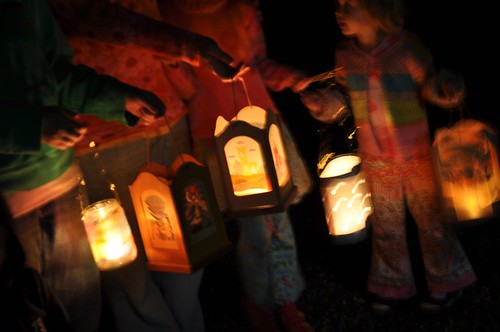
First, we make the lanterns.
Around the table, translucent colors are brushed onto paper. Leaves and stars may be pressed into the design. Wire handles are fastened, candles are fitted carefully inside, and the finished lanterns wait in the room while the November afternoons grow shorter.
The children know that these lanterns are being made for darkness.
Within the Waldorf festival year, Martinmas arrives at a particular threshold. Michaelmas has passed, with its call to courage and steadfastness. Advent has not yet begun. The last abundance of autumn is falling away, the trees are becoming bare, and the sun leaves us earlier each evening.
The outer world is growing darker.
At Martinmas, we do not try to make the darkness disappear. We meet it with a small light that has been kindled, protected, and carried by human hands.
The light we carry
The lantern is more than a beautiful seasonal craft. It offers the child a living picture of an inner light—small, steady, and worthy of care.
A lantern flame does not flood the whole path. It shows only the ground immediately before us. The child must walk slowly enough to keep it burning. The lantern cannot be swung carelessly or forgotten. Its light asks for attention.
This is part of the quiet wisdom of the festival. We do not need to see the entire road. We carry enough light for the next few steps.
For young children, this meaning does not need to be explained while they walk. Waldorf education often allows the gesture itself to speak. The child has made the lantern. The candle is lit. The path is dark. The light is entrusted to them.
They experience the image before they are asked to interpret it.
St. Martin and the warmth we give
At the heart of Martinmas is the story of Martin of Tours.
Before he became known as St. Martin, he was a young Roman soldier. On a bitterly cold night, he encountered a poorly clothed man at the city gate. Martin had no food or money to offer, so he drew his sword, divided his warm cloak, and gave half to the stranger.
The story is simple enough for a young child to hold: someone was cold, Martin noticed, and he shared what he had.
Yet within the festival, his deed carries the meaning of the lantern further. The inner light is not meant to remain hidden inside us. It becomes visible through what we do.
Martin’s compassion brought warmth into another person’s darkness. He did not wait until he could solve every hardship or give something grand. He responded to the person before him.
The lantern and the cloak belong together. One is the light we tend within; the other is that light becoming a deed of love.
This is why Martinmas is traditionally connected with generosity, warmth, and humble service. Families may gather coats, blankets, or food to share. They may bake for a neighbor or quietly help someone who needs care. These acts are not added to the festival as a lesson or project. They continue its central gesture.
Walking into the evening
The lantern walk begins near dusk.
Families gather while the last daylight fades. One candle is lit, and then another. Soon the children are standing together with little pools of gold glowing against the evening.
Then the procession begins.
A true lantern walk is usually quiet and unhurried. It is not a parade or performance. The darkness, the candlelight, the movement of the lanterns, and the sound of voices traveling together are enough.
Adults walk beside the children without filling every silence. A parent steadies a handle. An older child waits for a younger one. If a flame goes out, someone stops to help relight it.
Each lantern remains its own small light, yet together they illuminate the path.
The community does not remove the darkness for the child. It enters the darkness with the child, carrying light.
The songs we sing
The singing is not incidental to the lantern walk. It gathers individual families into one procession and gives the children something familiar to carry as they move through an unfamiliar darkness.
Among the songs often heard at Waldorf lantern walks is “I Go with My Little Lantern,” an English version of a traditional German Martinmas song. Its image is beautifully simple: stars shine above while the lanterns of the walkers shine below. The child’s small flame takes its place within a much larger world of light.
“Glimmer, Lantern, Glimmer” has a lighter, more woodland quality. Its gentle imagery belongs naturally to children moving beneath trees and listening to the small sounds of the evening. Sung softly and repeatedly, it can carry the procession without breaking its reverent mood.
Another traditional song is “Lantern, Lantern, Sun and Moon and Stars.” It places the handmade lantern beside the great lights of the heavens. The candle is small, but it participates in the same gesture of illumination.
Different Waldorf communities carry different songs, and titles or verses sometimes vary. What matters is not assembling a performance repertoire. A few simple songs, learned beforehand and sung without amplification, allow the group to breathe and walk together.
The songs return from year to year. At first, a small child may only listen from beside a parent. Later, the melody is familiar. Eventually, the child who once followed may sing strongly enough for someone younger to follow them.
A preparation for the inward season
Martinmas comes as the year begins turning toward winter and the inward season of Advent.
The lantern walk helps make that transition gently. At Michaelmas, courage may appear through the strong image of meeting the dragon. By Martinmas, courage has become quieter. It is the courage to carry a vulnerable flame through darkness, to notice another person, and to offer warmth.
Soon Advent will ask us to wait.
But first, Martinmas gives us a light to carry.
After the walk, families may return for warm soup, bread, or something simple to share. The lanterns are set down. Candles are extinguished. Children go home beneath the same dark sky through which they have just walked together.
The path will become dark again.
Yet something of the evening remains: the familiar songs, the story of a divided cloak, the warmth of other families nearby, and the experience of carrying a light that was small but sufficient.
That is why we walk with lanterns at Martinmas.
We are not pretending that darkness is absent. We are helping the child discover that light can be kindled within it—and that the light we carry becomes most meaningful when it brings warmth to someone else.
