
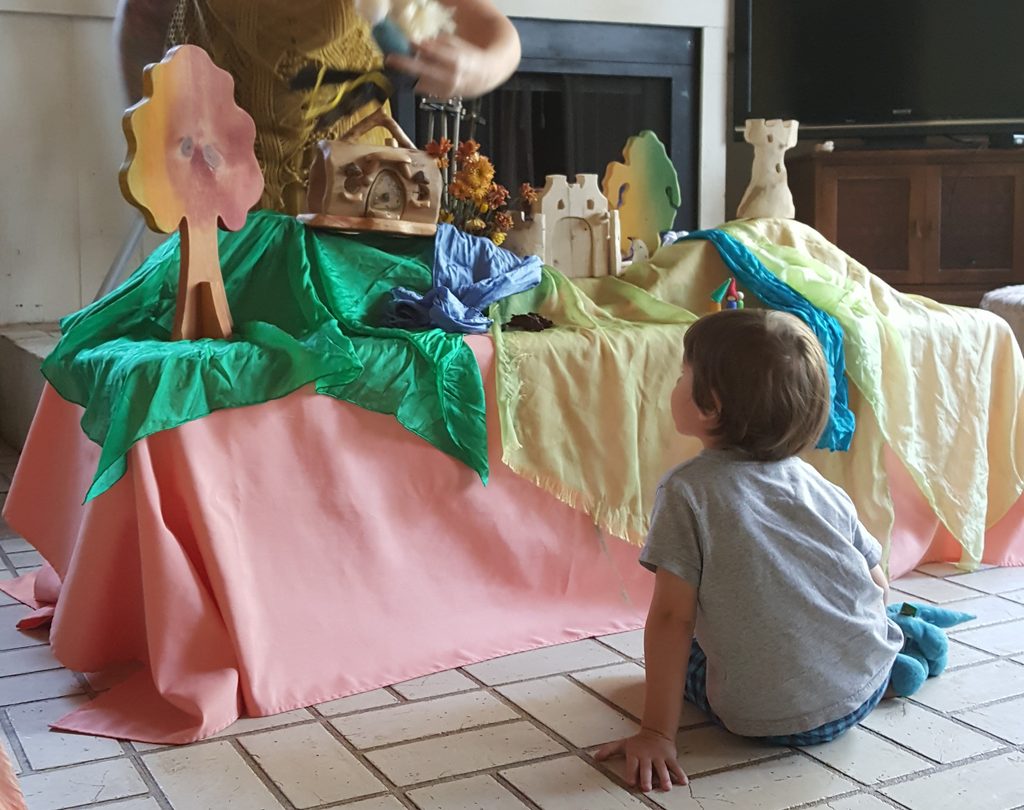
One of the hardest things about homeschooling can be believing that empty space is allowed.
A morning without an enrichment activity, an afternoon with nowhere to go, a child wandering outside with no particular assignment, or a long stretch of play that produces nothing we can put into a portfolio can all feel suspiciously unproductive.
And yet so much of childhood happens there.
In the spaces no one planned, a blanket becomes a roof, a branch becomes a fishing pole, and someone spends forty minutes digging a hole and will not explain why. Two children build a world beneath the dining-room table. A doll needs a coat, and suddenly scraps of wool and string have become an entire afternoon.
This kind of play needs room around it. It does not always survive being squeezed between appointments.

Waldorf homeschooling can offer children something increasingly rare: time that still belongs to them.
Not all day, not without boundaries, and not without chores, lessons, or responsibilities. But enough.
Enough time to become bored, enough time to move through the boredom, and enough time for something to begin.
A spacious childhood does not mean a childhood without learning. It means learning is not always being pushed toward the child from the outside.
Sometimes the child goes looking.
They notice the nest. They begin counting the shells. They want to know how the knot works. They ask where the moon went. They need to write a sign for the shop they have built in the hallway.
Curiosity rises naturally when it is given somewhere to rise.
This can require restraint from us. We see the nest and want to turn it into a bird unit. We hear the question and want to find a worksheet. We notice the game and begin thinking about how educational it is.
Sometimes we can simply answer the question, wonder aloud, or say, “Let’s look tomorrow,” and then leave the door open.
There are years ahead for specialization, schedules, deadlines, and productivity. Childhood does not need to rush toward them.
There is another kind of preparation happening now. The child is learning how to imagine, stay with something, notice, make, wonder, and be quietly alone without immediately needing entertainment. They are learning how to enter deeply into play with another child.
These things are easy to underestimate because they do not always leave evidence behind.
But they are not empty. They are foundations.
A spacious childhood is full of invisible work.
